You have surely wondered what is happening in Bolivia’s digital space. Perhaps you saw posts that in under a minute racked up hundreds or thousands of mocking reactions — as on 12 April when Paola Aguirre shared a photo of her daughter. Perhaps you saw pages suddenly fall, livestreams mass-reported, or accounts suspended after denouncing something. It happened with DTV, with María Galindo, recently with Guido Alejo, who reported that his broadcast was being mass-flagged while he was live. And the question was always the same: how do you prove something like this?
The answer is that inauthentic behaviour does not work in only one way. In Bolivia we have already seen different forms of digital guerrilla — from the “digital warriors” of 2016 to more sophisticated structures where automated accounts work simultaneously to install narratives, promote officials or attack critical voices. But there were also far more normalised forms within the Bolivian case: public officials, communications offices and state structures at various levels of government operating digitally to position narratives, amplify political content or attack adversaries. And this has happened regardless of ideological stance or political bloc. In some cases human operators; in others, automation; in others, both mixed together. The strategies change, but the objective is the same: to artificially influence public conversation.
What has changed in these years is the scale and the intent. Before, much of this was activated mainly around elections. Today it runs permanently. It is no longer just about inflating an administration or positioning a candidacy, but about generating social fracture, public humiliation and dehumanisation of the adversary. Today racism, stigmatisation and the animalisation of the other have stopped being isolated incidents and become part of a constant logic of digital operation.
This did not come from nowhere. Since 2019 Bolivia had already shown aggressive forms of digital diffusion, specifically against El Alto. Before that year, opposing structures coexisted — mass pages, aligned media and coordinated operations on both sides. But today the difference is the disproportion and the level of communicational hegemony. There are no longer equivalent counterweights in digital, media and economic capacity. Traditional media amplify content that is then reinforced artificially on social networks, generating a far more constant and effective machinery to install narratives, attack adversaries and naturalise hate speech.
In this context we are also living a moment of intense polarisation and social fracture, where even the presence of Fernando Cerimedo as one of the president’s principal advisers has been questioned. Cerimedo has been linked regionally to digital strategies, disinformation campaigns and political amplification operations in various Latin American countries. Regardless of whether these relationships are direct or not, many of those forms of digital operation are today more visible within the Bolivian ecosystem.
A recent example occurred after economist Gonzalo Colque’s post about aircraft CP-3243, linked to Minister Mario Justiniano. The post showed flight records with frequent routes between Santa Cruz, La Paz and Brazil, alongside legitimate questions about the aircraft’s use and its possible links to official agendas. What came next was a coordinated digital attack. Between 15:51 and 16:00 — roughly five minutes — the post received hundreds of hostile comments and mass “haha” reactions. In one specific second, 146 comments were registered. In total, more than 500 comments concentrated in a few minutes. That is not organic behaviour.
In one specific second, 146 comments were registered.
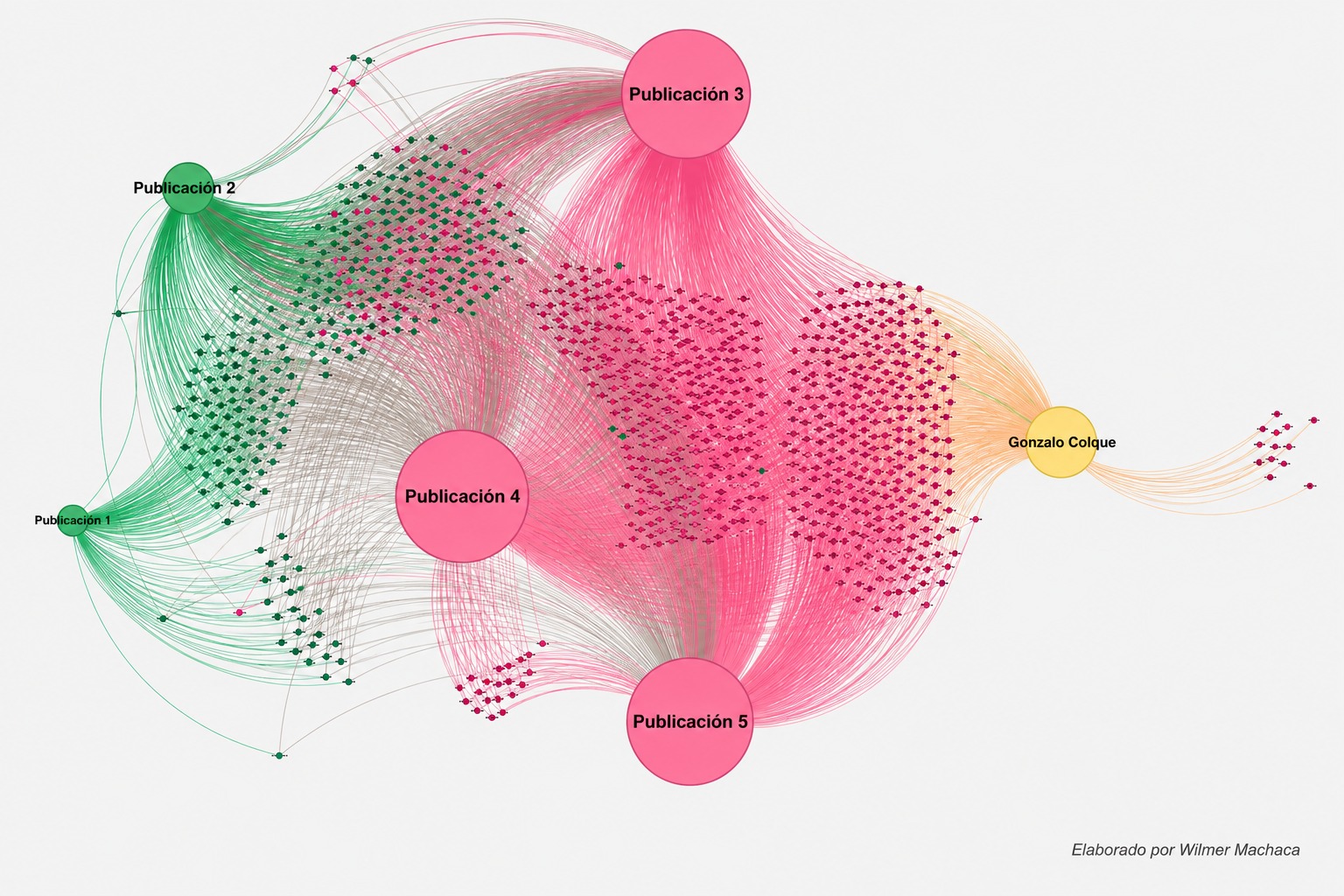
From there we began tracing patterns. We identified 375 accounts that commented repeatedly in that specific attack. Those accounts were then compared against posts from various ministries, especially the Ministry of Rural Productive Development and Land, headed by Mario Justiniano. The result was clear: many of the accounts attacking Gonzalo Colque also appeared systematically promoting ministry posts. Five different posts were compared and a persistent network of at least 1,025 accounts interacting repeatedly with each other was found.
The attached graph shows exactly that structure: in green, older posts; in pink, recent posts with far greater density and interaction; and in yellow, Gonzalo Colque’s post connected to that same network of accounts. The transition from green to pink shows something important: the capacity for artificial interaction and the scale of the digital guerrilla increased during the onset of the recent political conflicts.
These accounts also share similar characteristics. Many were created between 2025 and 2026, use very Bolivian local first and last names, most have their profile view restricted, and they present similar lexical patterns in their comments. The comments are not identical, but maintain extremely similar structures with small word variations, probably to keep platforms from automatically detecting automation or coordinated spam. They do not comment a hundred times; generally one or two comments per post, precisely to feign normal human behaviour.
This is not an isolated case nor a theory. It is just one example, on one platform, one among many, of how a digital guerrilla operates within the Bolivian ecosystem. What matters here is not only who attacks whom, but understanding that today there is an organised capacity to manipulate conversations, amplify hatred, install narratives and publicly harass those who make power uncomfortable.
This case also lets us observe something more important. Mario Justiniano is not only part of the state apparatus; he also concentrates economic capacity, media presence and digital reach. Today he is also the owner of one of the country’s most important media outlets, El Deber. Add to this an ecosystem where much of the traditional media is aligned with the government and where social networks function as permanent amplifiers of political narratives. The result is a disproportionate structure of communicational, media and digital influence that today has no equivalent counterweights within the Bolivian ecosystem.
And perhaps the most worrying thing is that, after so many years of permanent exposure to these digital dynamics, we have begun to normalise forms of violence, intolerance and dehumanisation of the other that today no longer stay only on social networks. Much of the rage, hatred and social fracture we now see spilling into the streets, the media and daily life has also been fed for years by this kind of digital campaign — where the political adversary stops being someone to debate and becomes someone to humiliate, destroy or symbolically eliminate.
I also attach (only 700 — Facebook won’t allow more characters) the list of accounts and the profile URLs of the analysed comments.