Data Investigation in progress
Who are you paying when the QR says Takenos?
A WhatsApp scam sends Bs 2,900 from my aunt to a QR. Three banking apps show the Takenos brand where the Central Bank’s rule asks for the name of whoever collects.
By Violeta Ayala — Tecnóloga
In short
- A WhatsApp scam sends Bs 2,900 from my Auntie M to a Takenos QR.
- Her bank shows TAKENOS and DESCONOCIDO where the BCB rule asks for the name of whoever collects.
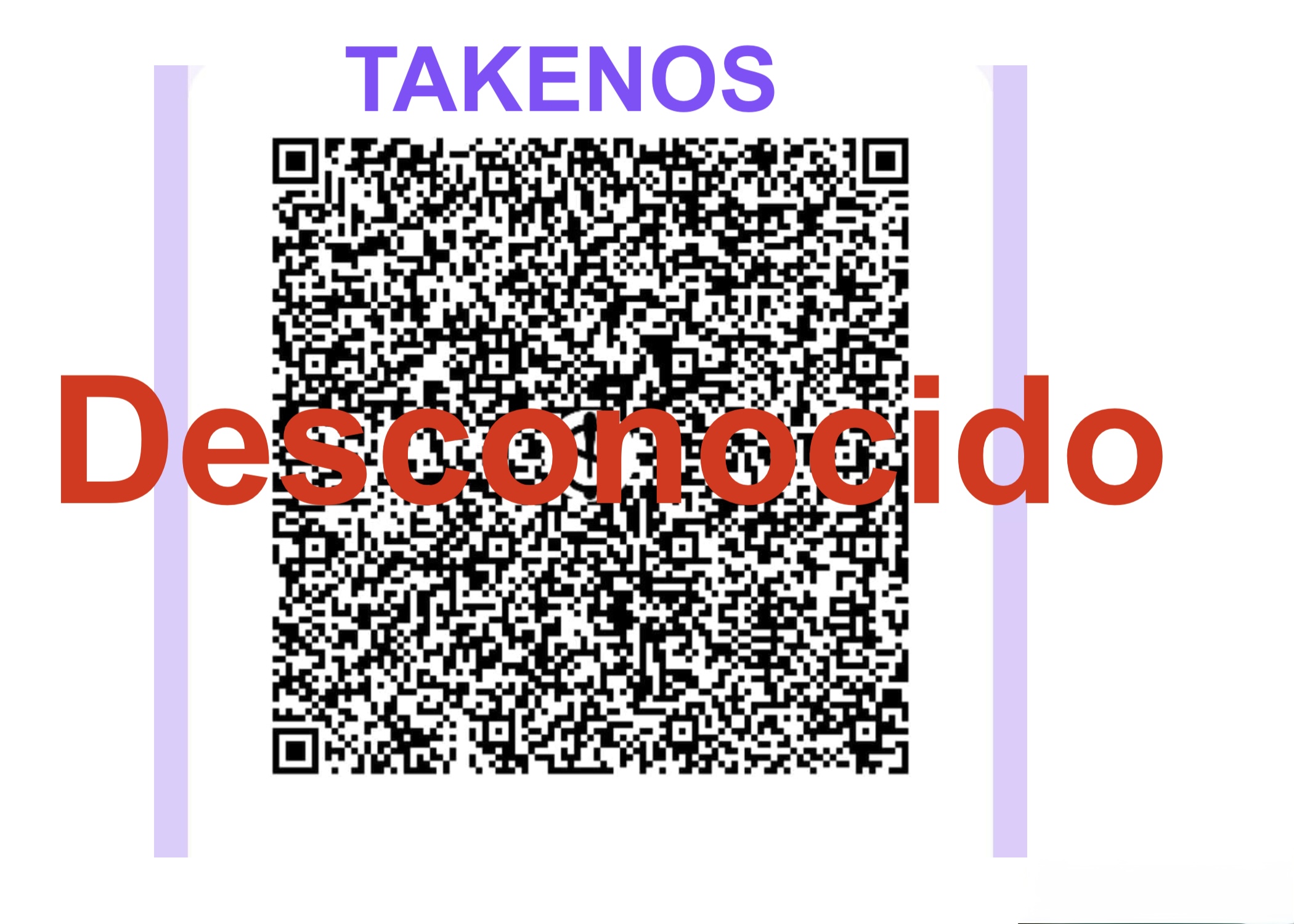
- The Takenos user's name appears in one place only: the image the user sends. The one my aunt received arrived without a name.
- Takenos operates in Bolivia through a local company, Inversiones Tanqueray S.A. Whether it holds an ASFI licence is unknown.
- I ask that every QR and every receipt show the name of whoever receives the money.
The message
On 5 October 2026, my Auntie M gets a WhatsApp message from my Auntie C. The name is the usual one. The number is the usual one.
"I wanted to ask you a huge favour."
Auntie C asks for Bs 4,900. She promises to pay it back within hours. She sends a QR code.
At 13:09, Auntie M transfers Bs 1,900 from her account at Banco Mercantil Santa Cruz. At 13:16 she transfers another Bs 1,000. Total: Bs 2,900.
Auntie C never wrote that message. Her WhatsApp account had been hacked. That day, whoever controls it uses it to ask for money.
Nobody breaks into Auntie M's online banking. Nobody steals a password. She confirms both transfers herself, sure that she is helping her family.
The method is on record. In January 2026, Red Uno reports on a woman in Cochabamba who loses Bs 3,840 after a request from her sister-in-law's WhatsApp. In September 2025, the head of Cybercrime at the La Paz Felcc says his unit receives two to three QR scam complaints a day.
The receipt
Two days later I sit down with Auntie M to follow the money. We start with her bank receipts. Both say the same, top to bottom:
- Cuenta destino: TAKENOS
- CI / NIT: 564163021
- DESCONOCIDO ("unknown")
- 27002124866658
The name of the person who receives my aunt's money is missing from the page.
The tests
One QR, three apps
I scan the same QR with Yape. The screen says: "Yapear a: Takenos". Below it: "Cidre IFD".
At 12:52 on 7 October I transfer Bs 1 to see the receipt. It says: beneficiary Takenos, account 27002124866658, destination Cidre IFD.
I read it with the Banco BISA app. It says: destination account TAKENOS, CIDRE IFD - 27002124866658.
All three apps agree on the name Takenos and on the account number. Yape and BISA name CIDRE IFD as the destination entity. The Mercantil Santa Cruz receipt prints DESCONOCIDO.
To compare, I generate my own QR in BISA and in Yape.
My personal QR
The QR from the scam
Transcription of the text on each screen and receipt, in the original Spanish. These are not screenshots. My name is replaced by brackets.
A colleague's QR
A colleague who uses Takenos sends me his QR. The image the app generates carries his name below the code.
I scan it with the Banco BISA app. The screen says: destination account TAKENOS, CIDRE IFD and a 14-digit number different from the one on Auntie M's receipt.
At 21:57 I pay him Bs 1 with Yape. The receipt says Takenos, destination Cidre IFD and the same number as the screen.
Two codes, two numbers. On screens and receipts, the name is Takenos.
My transaction list
In Yape, every payment in my transaction list shows the code of the destination bank and the name of whoever receives it. The two payments to Takenos QRs say "ICI - Takenos".
Transcription of my Yape transaction list. I hide people's names.
The image without a name
The image Auntie M received shows the code on Takenos's lilac background. It ends just below the code. On my colleague's card, that is where the name goes.
Across the screens and receipts I checked, the user's name appears in one place only: the image the user sends.
Who they are
CIDRE is a development finance institution (IFD) based in Cochabamba and supervised by ASFI, Bolivia's financial regulator.
Takenos is an Argentine digital wallet founded in 2022. In October 2025 it announces a USD 5 million round led by the US funds Variant and Lattice. Its country manager in Bolivia, Gonzalo Ostria, tells La Razón that the investors later added another 5 million.
On 22 March 2026, its representative in Bolivia claims more than 350,000 users. Six days later, La Razón publishes more than 280,000 active users in the country.
What Takenos says
Its public documents describe how QR collection works in Bolivia:
- A Bolivian user generates a QR in the app to receive bolivianos.
- They share it with anyone. They receive payments from their own accounts and from third parties.
- The bolivianos convert automatically to digital dollars and appear in the balance immediately.
- By default, the QR has an open amount and lasts one year. The ceiling is Bs 40,000.
- Since 19 May 2026, the QR is the only way to receive bolivianos in Takenos.
The terms of the service call these codes "personalised QRs". On the payer's screen, the QR says Takenos.
Who signs the contract
The general terms for Bolivian users name the provider of the service in Bolivia: Inversiones Tanqueray S.A. Takenos is the brand. In Argentina the contract names Global Flow S.A. For other countries it names Takenos INC.
The Bolivian document states that neither the company nor its third-party providers are financial entities regulated by the Central Bank of Bolivia. It also states that the company operates through third parties that hold licences.
What it can do in a case of fraud
Under its own terms, Takenos can:
- suspend, retain or annul operations when there are signs of fraud;
- retain a user's funds while it verifies an operation;
- return funds to their origin.
In its FAQ, Takenos says the QR payments its users make are "instant and irreversible".
What its manager in Bolivia says
On 28 March 2026, Gonzalo Ostria speaks to La Razón:
"Takenos operates within the formal regulatory frameworks of each country. We have the same control and reporting obligations as any actor that handles users' funds."
He names Chainalysis and SumSub as providers for fraud prevention and identity validation. The interview does not mention ASFI, the BCB or CIDRE IFD.
To anyone who hesitates to trust an app with their money, he answers:
"Any company that cannot answer doubts clearly does not deserve the user's trust."
What the rule says
The Central Bank of Bolivia (BCB) sets minimum security requirements for electronic payment channels. The document the BCB publishes on its site today orders web and mobile apps to display, before and after a transaction is confirmed, exact and complete information. This is how it compares with Auntie M's receipt:
| What the BCB requires | What the receipt shows |
|---|---|
| Name of the destination financial entity | CIDRE IFD does not appear. The receipt carries the word DESCONOCIDO ("unknown"). |
| Beneficiary's first and last name, or registered company name | TAKENOS, a brand |
| Beneficiary's identity card or tax number | 564163021, belonging to Inversiones Tanqueray S.A. |
| Beneficiary's account number | 27002124866658 |
| Amount and currency | Bs 1,900 and Bs 1,000 |
Comparison with the two Banco Mercantil Santa Cruz receipts.
The tax number belongs to Inversiones Tanqueray S.A., an active taxpayer, according to the national tax service lookup.
An earlier version of the BCB document, still hosted on its site, asked for entity, account, amount and currency. The beneficiary's name and identity number appear in the current version.
ASFI, in a note on QR use, tells the public that before confirming a payment it is essential to check that the receiver's name on screen is the right one.
The rule for fintechs
Supreme Decree 5384, of 7 May 2025, regulates Financial Technology Companies. It says they provide "services with technological innovation in the field of financial services". It requires them to incorporate as financial entities and apply to ASFI for an operating licence. Companies already operating in the country must adapt.
Takenos's terms describe Inversiones Tanqueray S.A. as "a company specialised in services with technological innovation in the field of financial services".
The counters
On 7 October the claims begin. This is what each institution answers:
Takenos No deadline given
We report the case to support with the QR, the receipts and the screenshots. Takenos opens a claim and passes it to a specialised team that will analyse the operations, the QR, the receiver's information and the traceability of the funds. It warns that it cannot guarantee recovery of the money.
At its office in Santa Cruz de la Sierra, by Auntie M's account, staff ask her to file a police report first so they can accept her letter. They tell her Takenos will follow the authorities' investigation.
Banco Mercantil Santa Cruz By 14 October
By Auntie M's account, the bank accepts her letter in person and promises a reply by 14 October.
CIDRE IFD Five business days
I write to them. The first reply recalls that account holders answer for operations made from their online banking. I explain that nobody entered my aunt's banking. CIDRE asks for the receipts, receives them and offers to notify Takenos. For a formal claim, Auntie M has to go to a branch in person.
"As a financial entity we can assist you by notifying the company Takenos of a presumed fraud."CIDRE IFD, written reply
What remains unknown
- What the number 27002124866658 is at CIDRE IFD: an account, a sub-account or an identifier. Whether it belongs to one Takenos user or to a single QR. Who appears as its holder.
- Which Takenos user generated the QR. Whether that user passed identity verification.
- When the Bs 2,900 converted to digital dollars. Whether the funds are still on the platform.
- Whether Takenos retained funds after the report.
- Who disabled the scam QR, and when.
- Which field in Banco Mercantil Santa Cruz's system prints the word DESCONOCIDO.
- Under which registration number and address Inversiones Tanqueray S.A. appears in the commercial registry. Who its shareholders are.
- Whether Inversiones Tanqueray S.A. holds or is applying for the licence ASFI has required since July 2025 from financial technology companies incorporated in Bolivia.
- Whether Inversiones Tanqueray S.A. appears in the UIF register of virtual asset providers.
- Who counts as the beneficiary for the BCB when a platform collects on behalf of one of its users.
Who took over Auntie C's WhatsApp and who received the money are facts yet to be established. This article does not attribute the scam to Takenos, CIDRE IFD or Banco Mercantil Santa Cruz.
On 7 October, two days after the scam, the QR still accepts payments: it takes my one-boliviano test. That night, after the report to Takenos, it is still active. On 8 October it no longer is.
Banco Mercantil Santa Cruz has until 14 October. CIDRE, five business days. Auntie M is preparing her police report.
The regulators
Bolivia opens the door to virtual assets in 2024. The rules for those who operate with them arrive later, with suspensions and extended deadlines.
In December 2024, GAFILAT rates the gap in oversight of virtual asset providers as minor, because the sector carries little weight. In April 2026, Takenos announces that Bolivia is its main market.
Tap each date to see the detail and the source.
What I ask
The scam on Auntie M is one more. Takenos, the banks and the regulators can prevent the next ones.
Takenos knows its users' names. It prints them on the card that comes with each QR. The banks' apps show the Takenos brand instead.
Whoever pays has the right to know where their money goes.
Takenos must send that name with every payment. The banks must show it on the QR screen and on the receipt. The BCB and ASFI must require it, including when the money arrives through a platform.
The BCB rule already asks for the beneficiary's name and identity number. What is missing is for that beneficiary to be the person who keeps the money.
With that name on screen, Auntie M would have seen who she was paying before she confirmed.
To those who promote Takenos
Takenos entered Bolivia with influencers, according to Fundación InternetBolivia.org. To those who promote it, I ask for more awareness. Your followers trust you. Before the next video, ask Takenos:
- Why does the payer's bank see "Takenos" and not the name of whoever collects?
- What does Takenos do when a QR used in a scam is reported? How long does it take to disable it?
- Does it hold an ASFI licence or a UIF registration?
- Who supervises the identification of its users in Bolivia?
This has to stop.
How this article was made
Auntie M is my aunt. I went with her through the claims and paid the one-boliviano test from my own account. Initials replace the names of my two aunts. A colleague with a Takenos account shared his QR for the comparison. In the transcriptions I hide the names of third parties.
I hold the receipts, the screenshots and the messages quoted. What happened at the counters is told from Auntie M's account. Quotes are translated from Spanish.
See all 23 sources
- Central Bank of Bolivia, Minimum Operational Security Requirements for Electronic Payment Instruments (ROMS): document published today (file ROMS 2025) and earlier version (file ROMS 2024).
- Servicio de Impuestos Nacionales, tax number lookup at siat.impuestos.gob.bo, October 2026.
- Supreme Decree 5384, 7 May 2025, at Lexivox.
- ASFI, El uso del QR ha dinamizado el sistema de pagos en Bolivia.
- Takenos, Terms and Conditions for Bolivian users.
- Takenos, Terms and Conditions, QR collections and deposits in Bolivia.
- Takenos, ¿Cómo puedo recibir Bolivianos en Bolivia?
- Takenos, Preguntas frecuentes sobre Pagos QR en Bolivia.
- Takenos, Terms and Conditions for Argentine users and for users in other countries.
- Takenos, Takenos announces $5M seed round, 6 October 2025.
- La Razón, Takenos: una billetera sin fronteras al servicio de la gente, interview by Pablo Deheza with Gonzalo Ostria, 28 March 2026.
- GAFILAT, Primer Informe de Seguimiento Intensificado de Bolivia, January 2025.
- Fundación InternetBolivia.org, Activos virtuales en Bolivia. Un año después, 18 July 2025.
- ABI, UIF suspende resolución sobre registro de proveedores de activos virtuales, December 2024.
- El Deber, Takenos inaugura su primera oficina comercial en Bolivia, 10 April 2026.
- CAINCO, Takenos en Bolivia: una herramienta para trabajar sin fronteras, 11 July 2025.
- C.R. & F. Rojas Abogados, Bolivia Updates the Regulatory Framework for Financial Technology Companies, 20 May 2026.
- Correo del Sur, Takenos, billetera virtual llega a usuarios de Sucre, 22 March 2026.
- Red Uno, "Pensé que era mi cuñada", 29 January 2026.
- Bolivia.com, Estafas con QR en aumento, with statements first reported by Visión 360.
- Urgente.bo, ASFI: empresas que operan con activos virtuales deberán tramitar una licencia.
- CIDRE IFD, Nosotros.
- El Peruano, Takenos, la billetera global, anuncia su llegada a Perú.