Data Ongoing investigation · Part three
How Do You Verify a Beneficiary Called TAKENOS?
CIDRE IFD, the institution through which Takenos collects in Bolivia, tells my aunt she should have verified the beneficiary’s identity before paying. On her receipt, the beneficiary was TAKENOS. Takenos suspends the account, promises to show the name of whoever collects “soon”, and declares confidential the authorisation under which it operates in Bolivia. The Prosecutor’s Office asks for a lawye
By Violeta Ayala — Tecnologa
This is the third story about the scam that sent my aunt M's money to a Takenos QR. The first: Who Are You Paying When the QR Says Takenos? The second: Takenos Admits It. When Will You See Who You Are Paying?
In short
- CIDRE IFD, the institution through which Takenos collects in Bolivia, tells aunt M the responsibility is hers and that she should have verified the beneficiary's identity. On her receipt, the beneficiary was TAKENOS.
- Takenos suspends the account that received the money and promises to show the name of whoever collects "soon". It gives no date.
- Asked under what authorisation it operates in Bolivia, Takenos replies that its operations are confidential.
- Aunt M reports the scam to the police. The next day, she says, the Prosecutor's Office asks for a lawyer's signature.
- In the first half of 2026, the police recorded 2,826 fraud complaints in Bolivia. Santa Cruz accounts for 35%.
CIDRE's letter
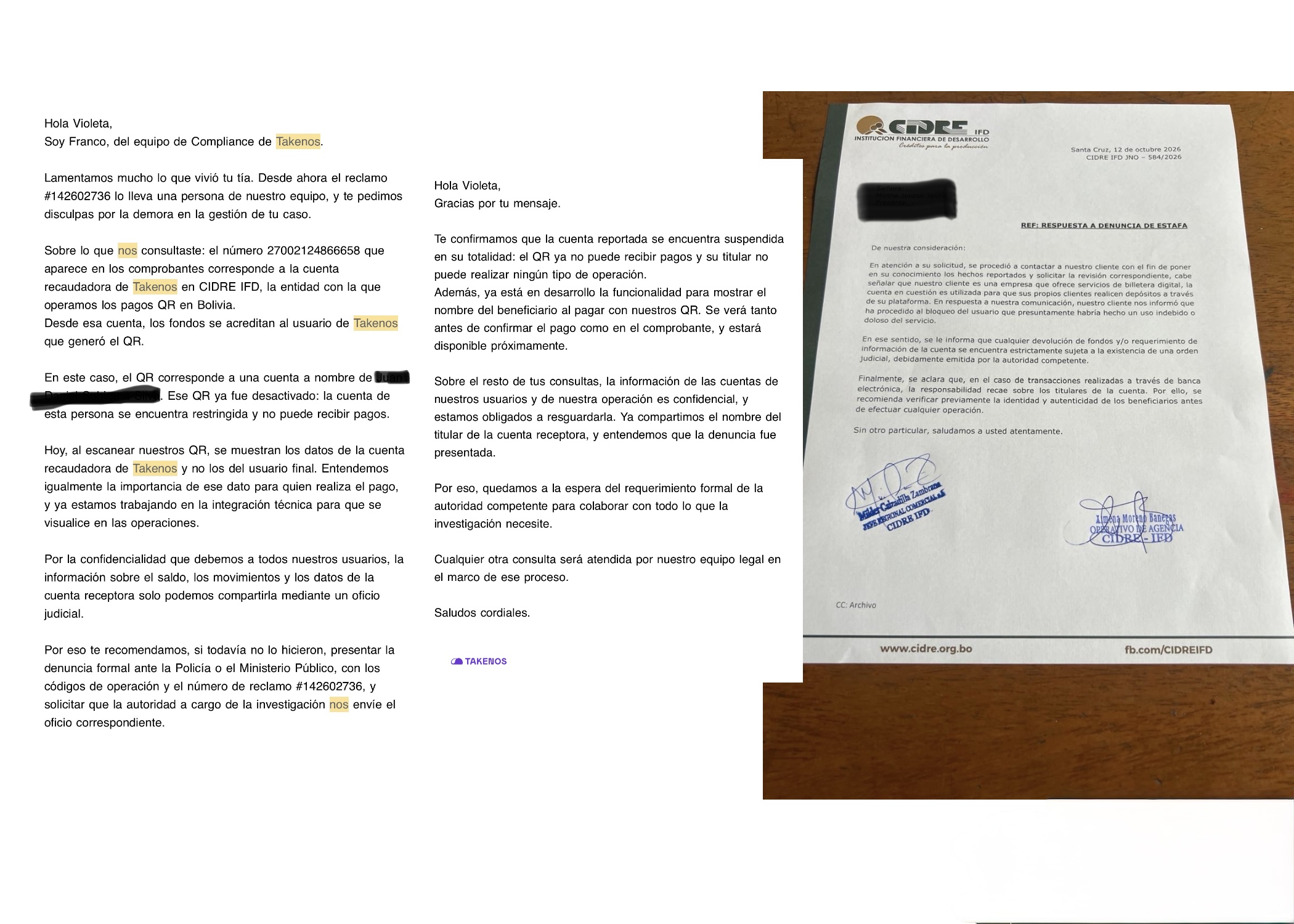
On 12 October, CIDRE IFD replies to aunt M by letter. It is signed by its regional sales office in Santa Cruz. The subject line reads "Reply to fraud complaint".
CIDRE does not name Takenos. It calls it "our client":
"Our client is a company that offers digital wallet services; the account in question is used so that its own clients can make deposits through its platform."CIDRE IFD, letter to aunt M, 12 October 2026
CIDRE says it contacted that client and that the client blocked the user who "allegedly made improper or fraudulent use of the service". To return funds or release account information, it requires a court order.
The last paragraph is addressed to aunt M:
"In the case of transactions made through online banking, the responsibility lies with the account holders. Therefore, it is recommended to verify the identity and authenticity of beneficiaries before carrying out any transaction."
The beneficiary
Aunt M paid with the Banco Mercantil Santa Cruz app. Her receipt showed as the destination:
- Destination account: TAKENOS
- ID / tax number: 564163021, belonging to Inversiones Tanqueray S.A., Takenos's company in Bolivia
- DESCONOCIDO (unknown)
- An account number
In Yape and in Banco BISA, the same QR says TAKENOS and CIDRE IFD. The person who collected appears nowhere.
Takenos confirmed it in writing on 13 October: "Today, when our QRs are scanned, the details of Takenos's collection account are shown, and not those of the end user."
CIDRE asks aunt M to verify the beneficiary's identity. On her receipt, the beneficiary was TAKENOS.
ASFI itself, in a note on QR use, asks the public to check that the recipient's name on screen is correct before confirming a payment. The Central Bank's security rules require payment apps to show the beneficiary's name before and after confirmation. Aunt M had no name to verify. She had a brand.
- How does a person verify the identity of a beneficiary called TAKENOS?
- Who answers for the name on the receipt: Takenos, CIDRE or the payer's bank?
- What does DESCONOCIDO mean on the Banco Mercantil Santa Cruz receipt?
Two versions of the same account
Takenos calls it "Takenos's collection account at CIDRE IFD, the entity through which we operate QR payments in Bolivia". From there, it says, the money goes to the user who generated the QR. According to its help centre, that QR receives payments from the user's own accounts and from third parties.
CIDRE says the account is for Takenos's clients to "make deposits through its platform".
Aunt M is not a Takenos client. She paid a stranger from her bank. CIDRE's description leaves out exactly that use: anyone, from any bank, can pay a Takenos user without seeing who they are.
- Does CIDRE know that the account receives third-party payments for Takenos users?
- What controls does CIDRE apply to those payments?
- How many collection accounts does Takenos hold at CIDRE? Another Takenos user's QR leads to a different number.
What Takenos says
On 15 October I sent Takenos thirteen questions. It answered two things.
First, that the account that received aunt M's money is "fully suspended": the QR no longer receives payments and its holder "cannot carry out any type of operation". It does not say whether the Bs 2,900 is still in that account.
Second, that it is already developing the feature to show the beneficiary's name. It will appear "both before confirming the payment and on the receipt", and will be available "soon". It gives no date.
About everything else, it writes:
"Information about our users' accounts and our operations is confidential, and we are obliged to safeguard it."Takenos support, 15 October 2026
It adds that it has already shared the account holder's name, that it is waiting for the formal request from the authorities, and that its legal team will handle any other enquiry within that process.
Inversiones Tanqueray S.A. does not appear on ASFI's lists of licensed entities or entities in the licensing process, as of 31 August and 16 September 2026.
Takenos treats the authorisation under which it operates in Bolivia as confidential.
- What date is "soon"?
- Under what authorisation does Takenos operate QR payments in Bolivia? Is it registered with the UIF, Bolivia's financial intelligence unit?
- What beneficiary name does Takenos send to the payment system for each QR today?
- How does it currently comply with the Central Bank rule that requires showing that name?
- When it received the report on 7 October, was the Bs 2,900 still in the user's account?
- What identity verification did the account holder pass before being able to collect?
- How many accounts did Takenos suspend in Bolivia in 2026 over fraud reports?
- To which legal entity and which address should the Prosecutor's Office send its request?
The complaint
On 14 October, nine days after the scam, aunt M files a fraud complaint with the police cybercrime unit (Felcc) in Santa Cruz. She says she transferred Bs 2,900 in two payments to an "unknown name, it only says TAKENOS". The report records the complaint verbally. No prosecutor has been assigned yet.
The next day, aunt M goes to the Prosecutor's Office. She says they ask her for several requirements and for her complaint to carry a lawyer's signature. They also ask for her home address and phone number.
Takenos and CIDRE say the same thing: without a court order, they return no funds and release no account information. Takenos says it has preserved the information. Everything depends on a prosecutor requesting that order.
Law 464 created the Plurinational Victim Assistance Service, which provides free legal assistance to crime victims who cannot afford a lawyer.
- Why does a victim need a lawyer's signature for a complaint the police have already registered to move forward?
- When will a prosecutor be assigned to the case?
- Who will request the court order from Takenos and CIDRE, and when?
- What happens to victims who cannot afford a lawyer?
Not an isolated case
On 12 October, El País published preliminary Bolivian police data, released by the Bolivian Observatory of Citizen Security and the Fight against Drugs:
The telecoms regulator, ATT, blocked 13,516 mobile devices and cut 10,846 lines. According to CiberLATAM, the head of the police Cybercrime Division says digital fraud has risen by up to 300%.
In El País, the police recommend verifying people's identity before depositing money. It is the same advice CIDRE gives aunt M. Neither explains how to do it when the QR does not show the name of whoever collects.
- How many of those complaints end at a QR that does not show who collects?
- How many go through wallets like Takenos?
- How many have a prosecutor assigned? In how many did the victim get their money back?
The law
Bolivia has no cybercrime law. Aunt M's complaint is for fraud, article 335 of the Penal Code, punishable by one to five years in prison. The hijacking of aunt C's WhatsApp comes closer to article 363 ter, on unauthorised access to and use of computer data. Article 363 bis punishes manipulating a computer system to divert money.
Identity theft has no article of its own. A table by Fundación InternetBolivia.org describes it without linking it to any article. In April, a criminal lawyer warned in El Diario that the country has no clear rules for digital evidence.
- When will Bolivia have a law against account hijacking and identity theft?
- Who is responsible, under the law, when a platform collects on behalf of a user nobody can see?
The questions nobody answers
To ASFI
- Can a company that does not appear on your lists operate QR payments through an institution you supervise?
- Have you reviewed Takenos's collection accounts at CIDRE?
- What do you do when a supervised institution tells a victim to verify a beneficiary its system does not show?
To the Central Bank of Bolivia
- Does a receipt that says TAKENOS and DESCONOCIDO comply with your rule?
- Who must send the beneficiary's name when a platform collects on behalf of a user?
To the UIF
- Is Takenos registered as a virtual asset service provider?
- Who supervises the identity of Takenos users in Bolivia?
To CIDRE IFD
- Since when has it worked with Takenos or Inversiones Tanqueray S.A., and under what contract?
- What did it check about that company before opening its accounts?
- How does this service fit its rural development mission?
- Do its funders know that CIDRE operates Takenos's collection accounts?
To Banco Mercantil Santa Cruz
- Why does your receipt not show CIDRE as the destination institution?
- What information did your system receive about the beneficiary of that payment?
What I'm asking for
From Takenos, I ask for a date for the change it promised. I also ask it to say under what authorisation it operates in Bolivia. That information protects no user.
From CIDRE IFD, I ask that it make possible what it asks of aunt M. If payers must verify the beneficiary, every payment into a Takenos account has to show the name of whoever collects.
From ASFI and the Central Bank, I ask that they make it a rule for everyone: no QR collects money without showing the name of whoever receives it.
From the Prosecutor's Office, I ask that it assign the case and request the orders from Takenos and CIDRE, with or without a private lawyer.
To you: until the name appears, a Takenos QR does not tell you who you are paying. If a relative asks you for money on WhatsApp, call them before you pay.
Whoever pays has the right to know where their money goes.
Did you pay a QR that said Takenos, and it was a scam? Don't let it go.
- Keep everything. The receipt, the QR and the chat screenshots. Don't delete anything.
- Report it to your bank and to Takenos. To Takenos, through the chat in its app. Ask both for a claim number.
- File a complaint with the police cybercrime unit (Felcc) or the Public Prosecutor's Office. Bring the receipts and the claim numbers. Takenos and CIDRE IFD say they release no account information without a court order, so ask the prosecutor to request it from both.
- If your bank doesn't respond, go to ASFI. You can take your complaint to the authority that supervises banks.
- Speak out publicly. Tell what happened on your social media. Cover your account number, your balance and other people's details.
- Send us your case at [email protected], with the date, the amount and what your receipt said. We won't publish your name without your permission.
How we did this story
Aunt M is my aunt. I am supporting her claims. CIDRE IFD's letter and the police complaint are in her name; I do not publish her details or the numbers of those documents. What happened at the Prosecutor's Office is told as aunt M recounts it. I also do not publish the name of the account holder that Takenos gave me: I do not know whether that person carried out the scam, lent their account, or had their identity used by someone else.
I keep the letter, the complaint and the emails cited. Quotes are translated from Spanish.
See the sources
- CIDRE IFD, letter replying to aunt M, Santa Cruz, 12 October 2026.
- Felcc Santa Cruz, aunt M's police complaint, 14 October 2026.
- Takenos, written replies from the Compliance team, 13 October 2026, and from support, 15 October 2026.
- El País, Policía boliviana atendió 2.826 denuncias de estafa en 6 meses, 12 October 2026.
- CiberLATAM, Bolivia: estafas digitales suben hasta 300%, 15 October 2026.
- ASFI, El uso del QR ha dinamizado el sistema de pagos en Bolivia, and Entidades Supervisadas con Licencia de Funcionamiento al 31.08.2026.
- Banco Central de Bolivia, Requerimientos Operativos Mínimos de Seguridad para Instrumentos Electrónicos de Pago.
- Takenos, ¿Cómo puedo recibir Bolivianos en Bolivia?
- Law 464 on the Plurinational Victim Assistance Service, on LexiVox.
- Penal Code, article 363 bis; Fundación InternetBolivia.org, cuadro de tipificación; El Diario, Vacío legal agrava riesgos de ciberdelitos en Bolivia, 13 April 2026.
- sala.red, Who Are You Paying When the QR Says Takenos? and Takenos Admits It. When Will You See Who You Are Paying?