By the October 2025 presidential run-off, Bolivia had endured nearly three years of dollar shortage, fuel queues and inflation above twenty per cent, the worst since the 1980s. Bolivians went to the polls and ended twenty years of the left’s political rule. On the surface it looked like the old story... The socialist government that seized resources for the majority, replaced by a centrist from a prestigious political family promising to reopen the country to private and foreign capital.
But appearances can hide the truth. Research carried out by Sala.Red indicates that voters were targeted by a hyper-segmented digital campaign: an AI-driven micro-targeting operation that fed different groups of voters exactly what they wanted to hear. According to that research, it was this machine that delivered the win and the presidency to Rodrigo Paz.
This was not an ideological revolution, but an algorithmic one. The old order couldn’t win on its own. Rodrigo Paz was polling in single digits until he bolted onto his ticket at the last moment a vice-president running mate the establishment would never have produced: Edmand Lara, a market-stall seller and ex-policeman fired for exposing corruption, with a vast TikTok following and no money. Many Bolivians said openly they were voting for Lara as if he led the ticket; it became a running joke that voters loved Lara but weren't sure who Paz was. The elite returned to power, but only by masking itself with the face of its opposite and running a hyper-segmented digital campaign of the kind the European Union had outlawed nine days before the run-off.
Sovereignty wasn't traded away; a sophisticated sleight-of-hand campaign had been run in Bolivia. The mandate was won on a set of promises that was reversed within weeks. Paz sidelined the vice-president who won him the election, and within months was negotiating the IMF loan he had campaigned against.
What Paz does with the resources is, so far, a direction, not yet a sale. The constitution still reserves lithium to the state, and he has promised: "I will not sell the Uyuni salt flat to make batteries." But the tilt is unmistakable, as the government calls for changes to the constitution.
What Paz does with the resources is, so far, a direction, not yet a sale. The constitution still reserves lithium to the state, and he has promised: "I will not sell the Uyuni salt flat to make batteries." But the tilt is unmistakable, as the government calls for changes to the constitution.
The country hasn’t gone quietly, enduring protests for the entire first half of 2026 from all sectors of society.
There are two honest ways to read this.
One: the extraction model is back, and the old order is handing the wealth back to private and foreign hands. The other: a bankrupt country is reopening to investment because there was no other way out of the crisis. Both are true. And both lead to the same question. With a new boom arriving, who is going to set the terms? On 27 April 2026, in Washington, a memorandum of understanding (MOU) on "critical minerals" was signed between Bolivia’s Mining Minister Marco Antonio Calderón de la Barca and the US Deputy Assistant Secretary Caleb Orr. No text was published of the agreement, although Washington released the equivalent agreements it signed with Peru, Uzbekistan, Mongolia and Britain.
The United States currently designates sixty minerals as critical to its economy and national security. Research published by Sala.Red has documented the presence of forty-seven of them in Bolivia. What portion of that extraordinary portfolio the memorandum covers is impossible to know, because the memorandum itself has not been made public.
Having identified the focus for this new “gold rush” Washington is trying to secure the supply of dozens of minerals. Australia and Bolivia both have the chance to capture the wealth for the public before private power and political short-termism close it again.
With this new resource window opening, lithium is one of the minerals leading the way. The 2026 US Geological Survey estimates Bolivia holds around 23 million tonnes of measured and indicated lithium resources; about 21 million tonnes of that is in the Salar de Uyuni, according to an estimate by SRK Consulting certified under the NI 43-101 standard. That compares with around 13 million tonnes in Chile and 10 million in Australia, two of the world's three largest producers. What Bolivia has not yet done is convert that enormous resource into an economically producing reserve, proving difficult due to the nature of its lithium.
Bolivia is negotiating with the USA from a brutal position. The country is facing its deepest economic crisis in decades. Its international reserves are overwhelmingly tied up in gold, usable dollar reserves have been depleted, the currency has sharply devalued, and fuel shortages have become chronic.
Despite these headwinds, there is a path to stronger terms. Bolivia must put its portfolio to a group of buyers, get them to bid and do it publicly, where parliament, civil society, the media and commentators together with rival bids can all potentially push the price up.
Bolivia's new government did the opposite. Within weeks of taking office, it was in Washington; within months it had signed the unpublished MOU.
Bolivia and Australia were both at the table of the 2026 ministerial where the US government launched its minerals alliance and signed a wave of bilateral deals. The alliance convened in Washington, with the stated objective of securing American critical-mineral supply chains as a matter of its own economic and national security.
Bolivia already has some two billion dollars in lithium deals with Chinese and Russian firms — agreements suspended and now under review by the new Paz government. Gulf money, other Asian capital, diversified Western investment are all within reach.
How does US power behave when a smaller country's strategic resources are at stake? In 1975 the question hung over a dismissal in Canberra, and the answer stayed classified. In 2026 it requires no conspiracies: the pressure is applied in the open.
In January 2026, US armed forces entered Caracas, captured Nicolás Maduro and removed him from power. There is no secret the US wants access to Venezuela’s vast oil reserves. Three months later, Bolivia signed its unpublished minerals memorandum in Washington. Every government in Latin America understood the demonstration of US power.
None of this means the memorandum shouldn't exist. Bolivia needs capital, badly, and Washington may yet offer terms worth taking — but no seller learns what its portfolio is worth from a single buyer in a closed room. Norway never sold to one suitor; it made the companies compete for acreage, round after round, under published rules. The argument is not against extraction, or against America — it is about the three tests that decide who the extraction serves. Capture the rent, at a rate worth capturing. Sustain the production that generates it. And ring-fence the savings where no government of the day can spend them. Norway passed all three. Australia has the institutions but lacks the will; Bolivia had the will and lacked the institutions.
Norway caught its window. In Australia, both leaders who seriously challenged the resource settlement were removed. Bolivia captured its gas windfall and spent it for want of a locked box.
There’s a rather ironic twist between Australia and Bolivia. Australia's wealth was built on iron ore mined in the Pilbara, and by some counts the largest single iron-ore deposit on earth is not in Australia but in Bolivia. El Mutún, a single mountain that contains some forty billion tonnes has been known about since 1848 but remains barely touched.
The Pilbara's iron waited once too: discovered in 1861, it wasn’t exploited until the 1960s, and for more than two decades before that an export ban made it pointless to mine. The Hancock dynasty was built in the Pilbara, and Lang Hancock and his daughter have fought greater public capture of Australia’s resource wealth ever since. The mountain of the very rock that made Australia rich sits in Bolivia, waiting. The geology was never the difference. The question, then, is not why Bolivia is poor or why Australia is rich. It is whether either can complete the stool before this boom passes the way the last ones did — capture the rent, sustain the production and protect the proceeds — before the lithium goes the way of silver, the potato, gas, and the leaf in the world's most famous drink.
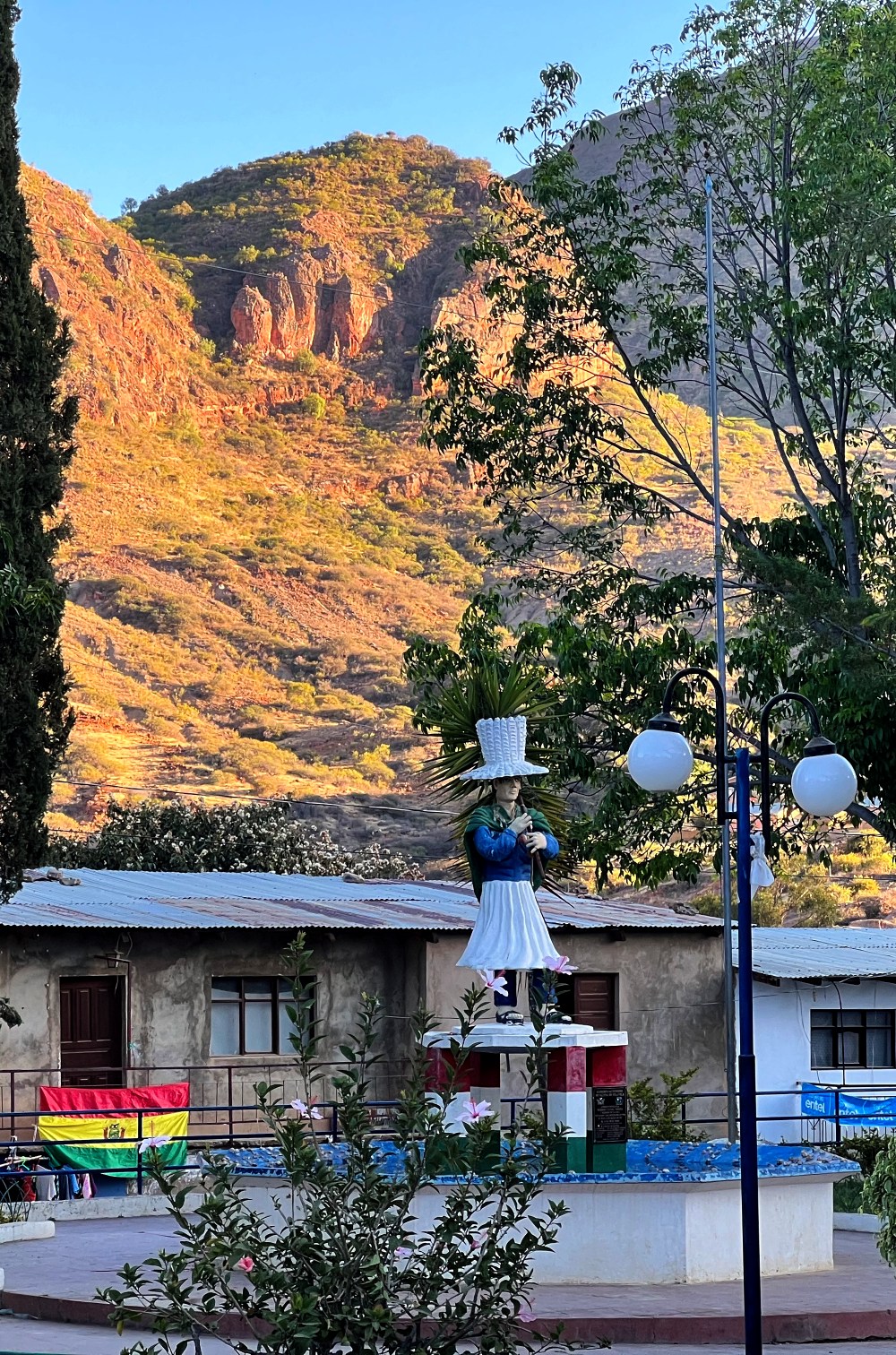
Drawing me back to the plaza in Cochabamba where this story began — the Coke, the chips, the free WiFi riding a signal Australia invented and then had to fight in court to be paid for, in Cochabamba the valley that once fed the silver mines of Potosí. It makes me think about a smaller town, several hours south, named Vila Vila, near the fossil beds of Tiupampa. In it stands a monument to the tradition at the heart of the town's identity, to the Lichiguayos, a group that play haunting flutes, performing in tunics and feathered hats, to the beat of leather drums. The dance has a figure who cracks a whip: the colonial overseer, the slave driver, his lash turned into a satirical instrument that keeps rhythm even as it mocks the authority it imitates. The people of Vila Vila understand the value taken under the lash. They made music of it and still dance to it.
Their satire is the analysis.
The wealth lies in this land.
The question this time, is whether it will stay.