Cables Analysis
The Landlocked Country the Data Runs Through
The United States revoked three Chilean officials' visas over a submarine cable. Bolivia has no coast, but the lowest-latency land route between the South American Atlantic and the Pacific runs across its territory: 55 milliseconds between São Paulo and Lima. Comteco, one of the cooperatives that built that road, has been paralysed for more than five hundred days.
By Violeta Ayala — Tecnóloga Creativa
The internet
It is eleven at night in Cochabamba and I write a message to my brother in Sydney, on the other side of the world, and it lands before I can put the phone down.
It left my phone, crossed Bolivia through a buried cable, left the country at a border, climbed up to a Pacific beach and went into the sea, because more than 95 percent of the world's data traffic travels along the ocean floor and satellites carry only a sliver.
Eleven at night in Cochabamba. The message crosses the country through buried fibre, climbs to a Pacific beach and goes into the sea.
The internet, which we were taught to picture as a cloud floating above our heads, sits under water, in the darkest and least watched place on the planet.
A submarine cable is about as thick as a garden hose, and inside it carries strands of glass as fine as a hair with light travelling through them, and that is all it is.
My message, your bank transfer, the video call with your son who moved to Spain, all of it is pulses of light crossing the ocean inside a tube resting on the seabed, among fish and anchors, at the mercy of any ship that drags its anchor where it should not.
How your internet travels
Tap each step of the journey.
None of it is natural or inevitable, because somebody paid for every cable, a ship laid it, a state authorised it, and a company that charges to go looking for it on the seabed repairs it.
Somebody decided where my message goes, and that decision, which sounds like engineering and municipal permits, is today one of the most political there is.
What happened in Chile
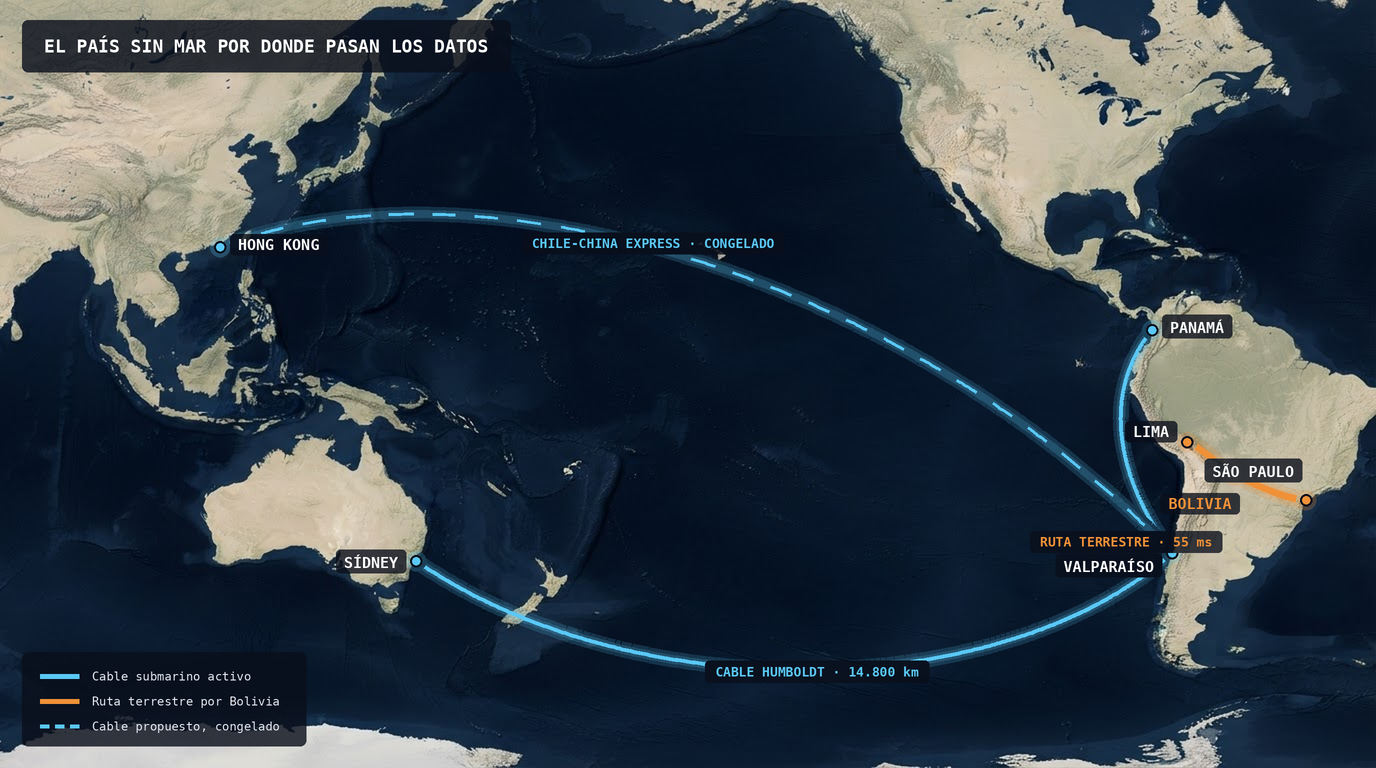
Chile is about to become the gateway for Pacific data into South America, through the Humboldt cable, built by Google with the state company Desarrollo País, which links the Chilean coast to Sydney across 14,800 kilometres with 16 fibre pairs, plus a second branch of 6,500 kilometres towards Panama City.
It is the first direct link between South America and Asia-Pacific. The regional commission in Valparaíso approved its installation in June 2026, the laying finishes this year and commercial operation begins between 2027 and 2028.
There was another cable on the table, the Chile-China Express, driven by China Mobile, which would connect Hong Kong with Valparaíso.
It is frozen. The file sits in the ministries of Defence and Foreign Affairs, and the telecommunications undersecretariat confirmed through a transparency request that it has issued no resolution.
One fact explains everything else. In February 2026, the United States revoked the visas of three Chilean officials over that cable: the transport minister, the telecommunications undersecretary and his chief of staff.
Visas revoked over a fibre optic project. That is what it is worth today to decide where a continent's data goes.
When a cable is cut
Around 200 submarine cable faults are recorded worldwide every year, most of them accidents involving fishing gear and anchors, though not all of them.
The cables connecting the island of Matsu to Taiwan were cut more than twenty times in five years, and in 2023 the island spent more than fifty days without internet, where sending a text message took twenty minutes and people gathered at night outside the phone company's shops looking for a signal.
In February 2024, four damaged cables in the Red Sea disrupted an enormous share of the traffic between Europe and Asia.
Hong Kong has twelve cable systems landing on its territory, which makes it a global hub and, at the same time, a target.
The route we do have
Bolivia has no coast, so it cannot have a cable landing, and we are never going to be Valparaíso.
What we do have is the other half of the business, the one almost nobody talks about: the lowest-latency land route between the South American Atlantic and the Pacific runs across Bolivian territory.
Since 2024 Entel has run a fibre network linking São Paulo with Lima across Bolivian territory, and the latency dropped from around 150 milliseconds to 55, less than half.
Its head of technology put it plainly: it is the lowest-delay route between the two oceans, thanks to Bolivia's geography. It is the only Bolivian operator with a direct presence in Lima and São Paulo, and it plans to reach Santiago.
The two routes between oceans
A diagram, not a map. Tap each point.
Ochre: the Bolivian land route · Terracotta: the long way round and the frozen cable · Magenta: the Humboldt cable · Teal: landing points and presence
16.1 million dollars
via Desaguadero and Tambo Quemado
Figures from Entel, the Bolivian Information Agency, TeleSemana and Mobile Time coverage of the COTAS project, and the presentation of Comteco's network. The Comteco figure comes from the original announcement of that network and needs updating.
Comteco, the Cochabamba cooperative, built 800 kilometres of its own network with two exits to the Pacific, one towards Desaguadero on the Peruvian border and another towards Tambo Quemado on the Chilean border.
When it was presented, the cooperative's president said it was the only one in the country with a Pacific exit through two neighbouring countries. The road exists. It is built.
What it means
A cable was never a neutral pipe, because whoever lays it chooses where it runs, who repairs it, under which jurisdiction the traffic travels and who can demand legal access to what moves inside it.
That is why the United States revoked three Chilean officials' visas, and why ships loiter over cables in the Taiwan Strait, and why what was for decades a matter for telecommunications engineers is now discussed in defence ministries.
Bolivia spent years renting international connectivity from wholesalers in Chile and Peru, and every packet of data that leaves here still crosses somebody else's infrastructure, under somebody else's laws, without anyone asking us anything.
Being a transit route changes that position completely, because a country that other people's data passes through stops being merely a customer: it charges a toll, it sits down to negotiate with something in hand, and it finally has a concrete reason, measurable in money, to demand that its own traffic be protected.
There is something larger. The whole world discovered at the same time that cables get cut and that a single maritime corridor can leave half a region blind.
The technical answer to that is called redundancy: alternative routes to divert traffic through when the main one fails. A fast land route in the middle of the continent is exactly that, and Bolivia does not need to compete with the sea to offer it: it needs to be South America's plan B.
What stops us
While Chile argues geopolitics with Washington and Beijing, in Cochabamba the cooperative that has that road already built has spent more than five hundred days in institutional crisis.
The violence began on August 27, 2025, and from then on the members held a vigil at the doors of the El Prado building demanding audits, while administrative staff controlled the entrance. The owners of the cooperative, months out on the pavement, and almost none of it reached the press.
The root goes back further. In November 2023, the Plurinational Constitutional Court overturned and annulled Comteco's 2021 electoral process, and since then the legitimacy of whoever is in charge has been in dispute.
Only in April 2026 did the cooperative ask the Supreme Electoral Tribunal to call full elections. The president of the board acknowledged that the conflict had been marked by acts of violence, irregular occupations and disruption to services.
I write this as a member of Comteco, which is also why I can say the following: the board is sealed off and does not speak to the members, does not sit down with them, does not account for anything and does not report on the state of the network those members paid for over decades.
More than 120,000 of us own that cooperative and not one of us has any way of knowing what is being decided in our name.
That is what stops us. Not the geography, not the lack of money, not competition from Chile.
It is that the institution holding the road to the Pacific has spent two years unable to decide who runs it, with the assets of more than 120,000 members caught in the middle. A fibre network is worth nothing if the organisation administering it cannot sign a contract.
The sum
Do the sum. Laying a submarine cable like Humboldt costs hundreds of millions of dollars, years of permits, environmental studies and negotiation between states. Bolivia cannot do that, and does not need to.
The COTAS interoceanic backbone was budgeted at 16.1 million. Comteco's network with two Pacific exits was built with five. Those are figures a country in crisis can debate in a single session of the Assembly.
Imagine the other version, the one that can still be built: Bolivia as the continent's emergency route, so that when a cable is cut in the Pacific the traffic of half of South America is diverted through here and somebody pays for the passage.
Data centres installed where power is cheap and the climate is cold, engineers trained here to run that network instead of leaving for Santiago or São Paulo, and a state with something to answer back with on the day somebody comes to tell it where its own information may and may not travel.
Geography already gave us the advantage, because the cordillera and our position at the centre of the continent mean the fastest route between the two oceans runs through here, and that cannot be bought, cannot be negotiated and cannot be taken from us.
What is missing is everything else: institutions that work, cooperatives that do not spend two years paralysed by a fight over chairs, a regulator whose rulings are actually enforced, and a state policy that treats fibre optics as what they are, strategic infrastructure, and not as one more spoil to divide up.
Chile is fighting two world powers over who gets to lay its cable. We already have the route built and we stop ourselves.
Meanwhile, my message still leaves the country through somebody else's cables.
Sources
- Government of Chile, the telecommunications undersecretariat, and coverage by Ex-Ante, T13 and Radio Universidad de Chile, June 2026: approval of the Humboldt Fibre Optic Cable System by the Valparaíso regional coastal-use commission, the routes towards Sydney and Panama City, the laying and operation timetable, and the frozen status of China Mobile's Chile-China Express project between Hong Kong and Valparaíso.
- Ex-Ante, June 2026: the February 2026 revocation of the US visas of transport minister Juan Carlos Muñoz, telecommunications undersecretary Claudio Araya and his chief of staff Guillermo Petersen.
- The Diplomat, May 2026, and international coverage from 2025 and 2026 on the repeated cutting of submarine cables off the Matsu islands and in the Baltic, and the annual average of faults estimated by the International Cable Protection Committee.
- Reports on the damage to four submarine cables in the Red Sea in February 2024 and its effect on traffic between Europe and Asia, and on the twelve cable systems landing in Hong Kong.
- Entel Bolivia, the Bolivian Information Agency and TeleSemana, 2025: consolidation of the Interoceanic Fibre Optic Network, a point of presence in São Paulo added to the Lima route operating since 2024, the latency reduction from around 150 to 55 milliseconds, statements by national technology manager Pablo Rocabado, and a fibre network exceeding 42,400 kilometres in the first half of the year.
- eju.tv, July 2026: Bolivia's integration into the Bioceanic Digital Corridor and the region's traffic exchange nodes.
- Mobile Time, May 2025: the COTAS interoceanic backbone project with the Colombian firm OSC Top Solutions Group, 1,850 kilometres and 16.1 million dollars of investment.
- Los Tiempos, October 2017: presentation of Comteco's national fibre optic network, 800 kilometres with Pacific exits via Desaguadero and Tambo Quemado, an investment of 5 million dollars and statements by the then president of the board.
- Los Tiempos, March 25, 2026: a day of violence at the El Prado premises, the members' sustained vigil demanding audits, and a representative's account of blows, tear gas and injured people.
- sala.red's own video record of the start of the confrontations on August 27, 2025 and the members' sustained vigil at the cooperative's doors over the following months, a period with scarce press coverage.
- Los Tiempos, April 7, 2026: Comteco's request to the Supreme Electoral Tribunal to call full elections after more than 500 days of institutional crisis, statements by the president of the board on acts of violence and irregular occupations, and the figure of more than 120,000 members.
- Los Tiempos, November 2023: the overturning and annulment of Comteco's 2021 electoral process ordered by the Fourth Specialised Chamber of the Plurinational Constitutional Court.
- Los Tiempos, January and February 2025: the reported alleged embezzlement, cash withdrawals without full justification, the dispute between rival authorities, and the general manager's warning about the risk to services and the debts owed to providers. Los Tiempos, September and November 2025: members demanding the return of their contributions and the distribution of surpluses, and the description of the crisis as the deepest in decades. The 21 observations on contracting and administration processes come from the Authority for the Oversight and Control of Cooperatives.
The author is a member of Comteco and states so in the text; her membership grants her no office, representation or privileged access to the cooperative's information. The facts about the cooperative correspond to complaints and administrative and judicial disputes in progress, attributed to those who made them, and no person mentioned has been convicted; the presumption of innocence applies. Accounts of the violent episodes are contested: this piece carries the complaint of the members holding the vigil and the public characterisation made by the president of the board, and sala.red has requested the other parties' version. The technical figures for Comteco's network come from the original announcement of that infrastructure and require updating with the cooperative, which sala.red has asked for information. The reading of Bolivia's potential as a transit route is interpretive and rests on the latency figures published by Entel and on the coverage cited.